
5. Conservation and Storage
The warehouse and cold storage rooms represent the true thermal shield of your establishment. In this module, you will learn to impeccably manage the cold chain, hot holding, and rotation systems FIFO and FEFO. This will allow you to ensure that each product is correctly labeled and fully traceable from reception to service.
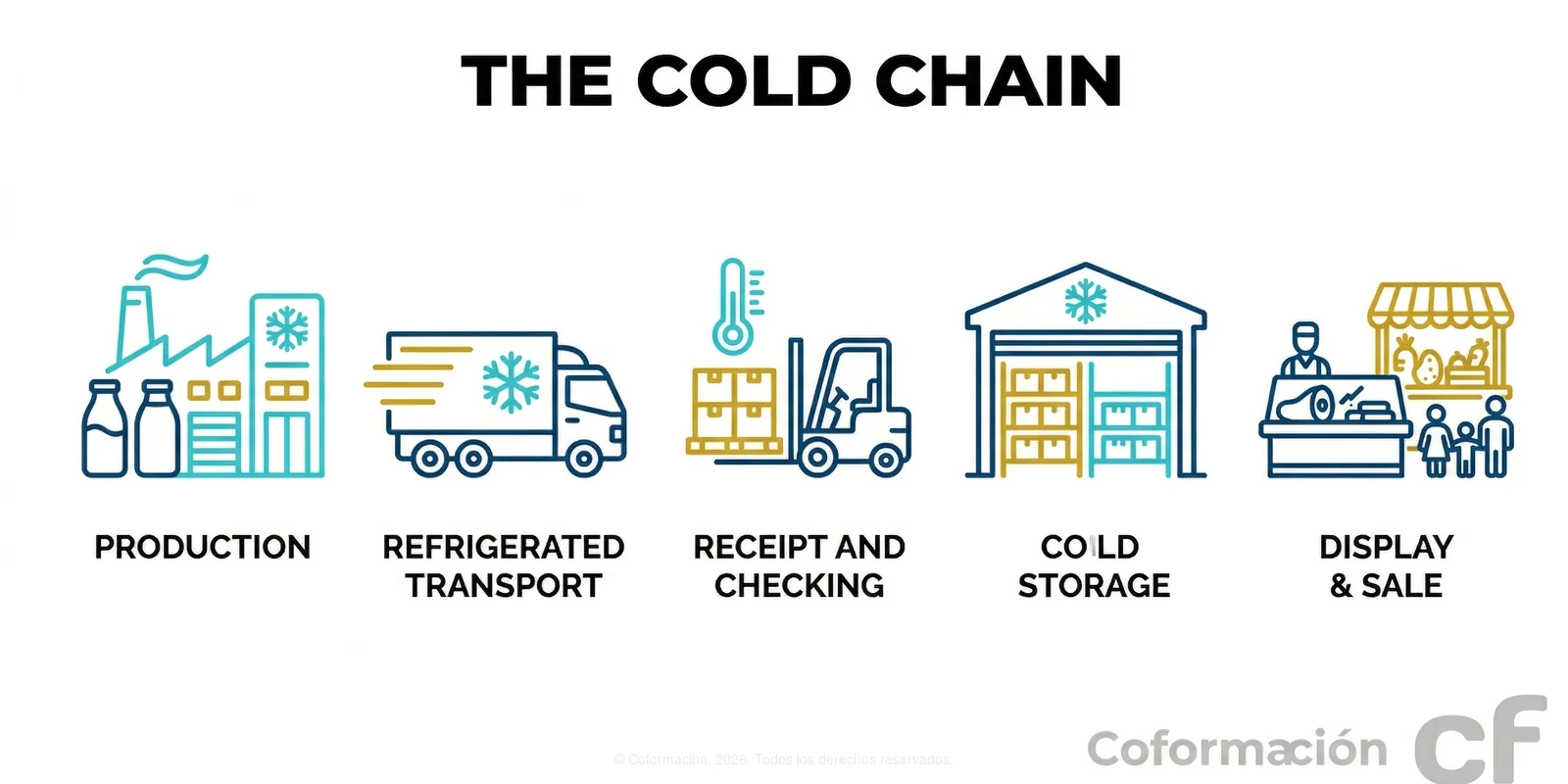
5.1. The Cold Chain
5.1.1. Refrigeration
Most potentially pathogenic microorganisms grow rapidly and multiply in a very short time between 5 and 65ºC (AESAN. (n.d.)).
Cold does NOT destroy microorganisms, but it DOES slow down or stop their development. Although these microorganisms can be partially or totally destroyed with thorough cooking, until the moment of cooking arrives, we must try to reduce this hazard by maintaining an appropriate storage temperature. For this reason, food should be at room temperature for as little time as possible, especially in summer, as a rapid growth of microorganisms in the food can occur.
The ideal refrigeration temperature ranges between 0 and 5ºC.
5.1.2. Freezing
Freezing is a safe method of food preservation that extends its shelf life and in turn contributes to reducing food waste. If food is kept at constant temperatures of -18°C or lower, the microorganisms that alter them and can cause diseases are inactivated (AESAN, 2021).
Freezing does NOT destroy these microorganisms, but it DOES stop their growth.
Upon thawing and as the temperature increases, microorganisms reactivate and multiply, potentially causing food poisoning.
The freezing power or the level of cold that a freezer reaches is measured in stars. In this way, + stars → + cold the freezer can reach.
5.1.3. Thawing
Frozen foods may contain bacteria that can proliferate after thawing and cause food poisoning. Therefore, good thawing practices reduce the probability of contracting foodborne illnesses (AESAN, 2021).
Permitted Methods:
- Thawing food in the refrigerator: It is the safest method, in the coldest part.
- Thawing in the microwave: It is suitable for rapid thawing. The "defrost" function should be used, and it must be ensured that the food is cooked immediately after, as the microwave can partially cook some areas.
- Thawing directly during cooking: Some foods can be cooked directly from frozen, such as vegetables or burgers. This method should only be used when the food label so indicates.
- Thawing with cold (running) water: It is a permitted method, but ensuring that the food is in a watertight container to prevent water contamination.
NON-Permitted Methods:
- Thawing at room temperature: It is not allowed because at temperatures between 5 and 65ºC microorganisms can reproduce more quickly, putting food safety at risk.
- Thawing with hot water: It is not allowed because it promotes microbial growth.
- Thawing and re-freezing: Re-freezing food is not allowed, as successive freezings reduce quality and facilitate contamination.
5.2. Thermal Treatment
Thermal treatment is fundamental to eliminate pathogenic microorganisms in food. Therefore, both the cooking temperature and the application time are key factors in guaranteeing food safety.
Additionally, hot holding of prepared foods is also very important. Cooking does not always eliminate certain bacteria, especially those that form spores; therefore, if food is not kept at an appropriate temperature, microorganisms can multiply again and represent a risk.
In general, most pathogens can develop in food when they are in a temperature range between 5°C and 60°C (danger zone), as it favors their growth.
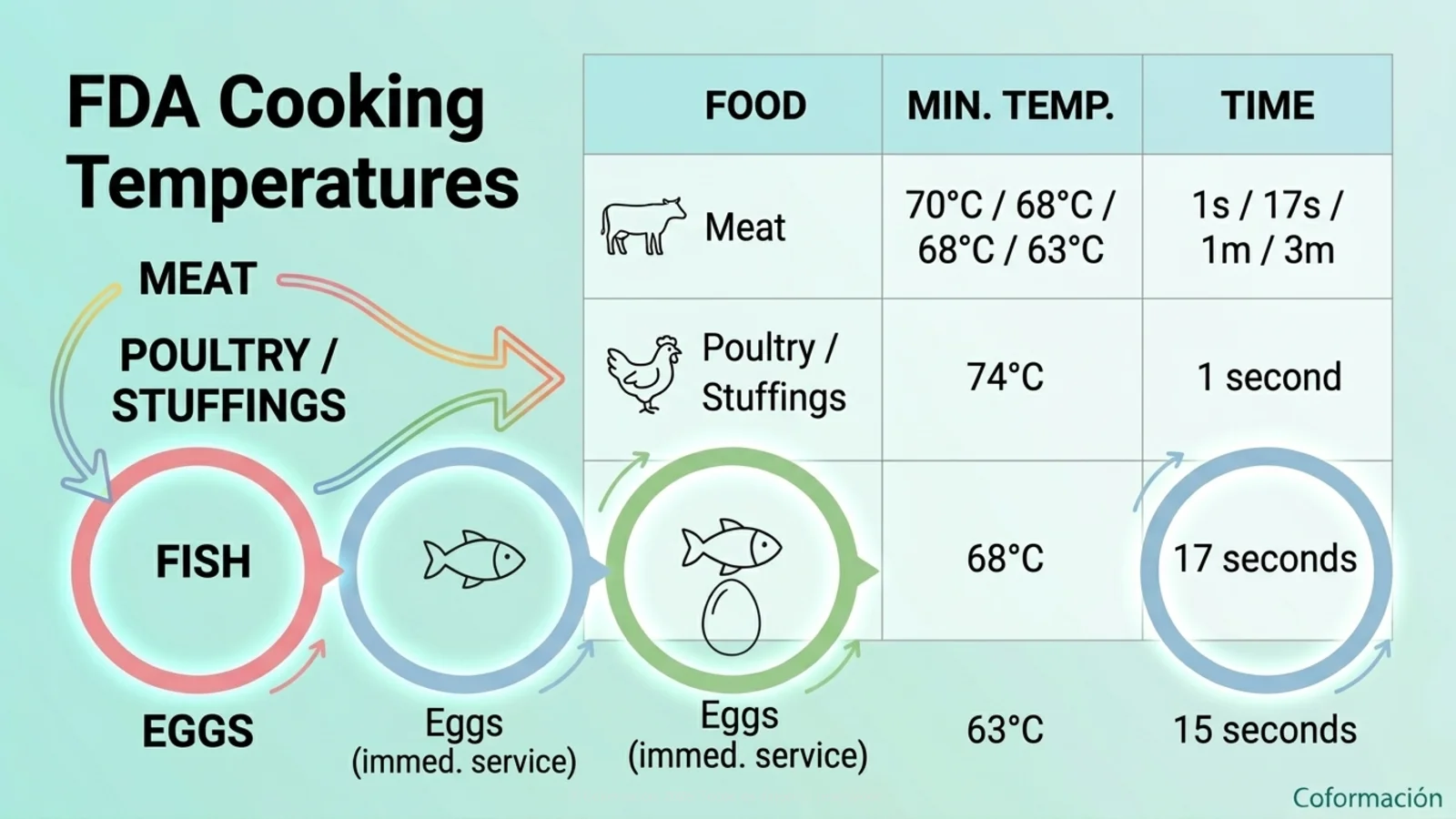
5.2.1. Cooking
Spanish legislation does not establish cooking temperature requirements. In the United States, the Food and Drug Administration (FDA) establishes time-temperature combination recommendations for cooking food in the Food Code (AESAN, 2021). Depending on the food, recommended temperatures generally vary between 60 - 74ºC. It should be noted that this temperature must be reached in all parts of the food, which is why it is indicated as internal temperature.
5.2.2. Hot Holding
In Spain, according to Spanish legislation, storage, conservation, transport, sale, and, where applicable, service temperatures for prepared meals kept at a regulated temperature, shall be ≥ 65°C in the case of hot meals (BOE-A-2001-809).
Note. There is a 2-4 hour rule (Comunidad de Madrid, 2016). If you have left food at room temperature...
- More than 4 hours: Do not consume it.
- Between 2 and 4 hours: Consume it immediately.
- Less than 2 hours: You have 3 options:
- Consume it immediately.
- Cool it in the refrigerator or freezer.
- Heat it to >65ºC.
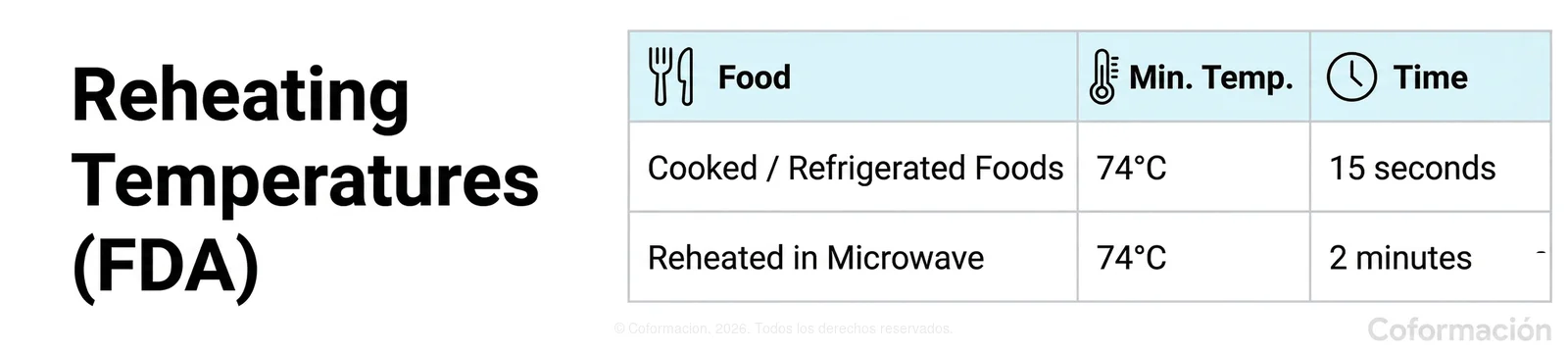
5.2.3. Reheating
Reheating of prepared meals must be carried out at temperatures ≥ 74°C in the center of the product during at least 15 seconds.
5.2.4. Chilling (Blast Chilling)
In the case of cooked meals, taking existing recommendations into account, they must be refrigerated quickly, reaching a center temperature of 4ºC in 2.5 hours and subsequent storage at temperatures of ≤ 4°C. That is, the internal temperature of the product must drop from >60ºC to <5ºC in less than 2 hours (AESAN, 2021).
5.3. Stock Management
Having good storage practices in warehouses and refrigerators is fundamental to avoid food contamination, maintain quality, and prevent foodborne illnesses. These practices allow for the control of biological, physical, and chemical risks, ensuring that food reaches the consumer safely.
Main reasons:
- Prevent cross-contamination: Separating raw foods from cooked ones prevents bacteria such as Salmonella or E. coli from transferring to ready-to-eat foods.
- Avoid contamination by contact with dirty surfaces: Placing food on the floor can expose it to dust, dirt, or pests. To guarantee food safety and avoid contamination by contact with the floor, products must be stored elevated ≥ 15 cm from the floor. Example: always use shelves or pallets.
- Avoid the absorption of harmful substances or deterioration due to unsuitable materials: Cardboard can become damp and allow the development of mold or bacteria. Example: use plastic containers or clean boxes specific for food.
- Maintain adequate temperature and humidity control: Proper storage helps ensure that food does not enter the "danger zone" (5°C - 60°C). Example: do not overload the refrigerator so that air circulates and maintains a uniform temperature.
- Facilitate rotation and stock control: Apply FIFO methods (first in, first out) or FEFO (first expired, first out). Example: place older products at the front and new ones behind.
5.4. Labeling and Traceability
Traceability is defined in Regulation 178/2002 as the ability to find and follow the trail, through all stages of production, processing, and distribution, of a food, a feed, or an ingredient.
This tool is key to protecting consumers, as it allows for the rapid withdrawal from the market of products that present a problem and provides clear and precise information about them to consumers (AESAN. (n.d.)).
To guarantee traceability, food business operators must have a system that allows them to identify their immediate suppliers and their immediate customers (except the final consumer). This is known as the "one step back and one step forward" approach.
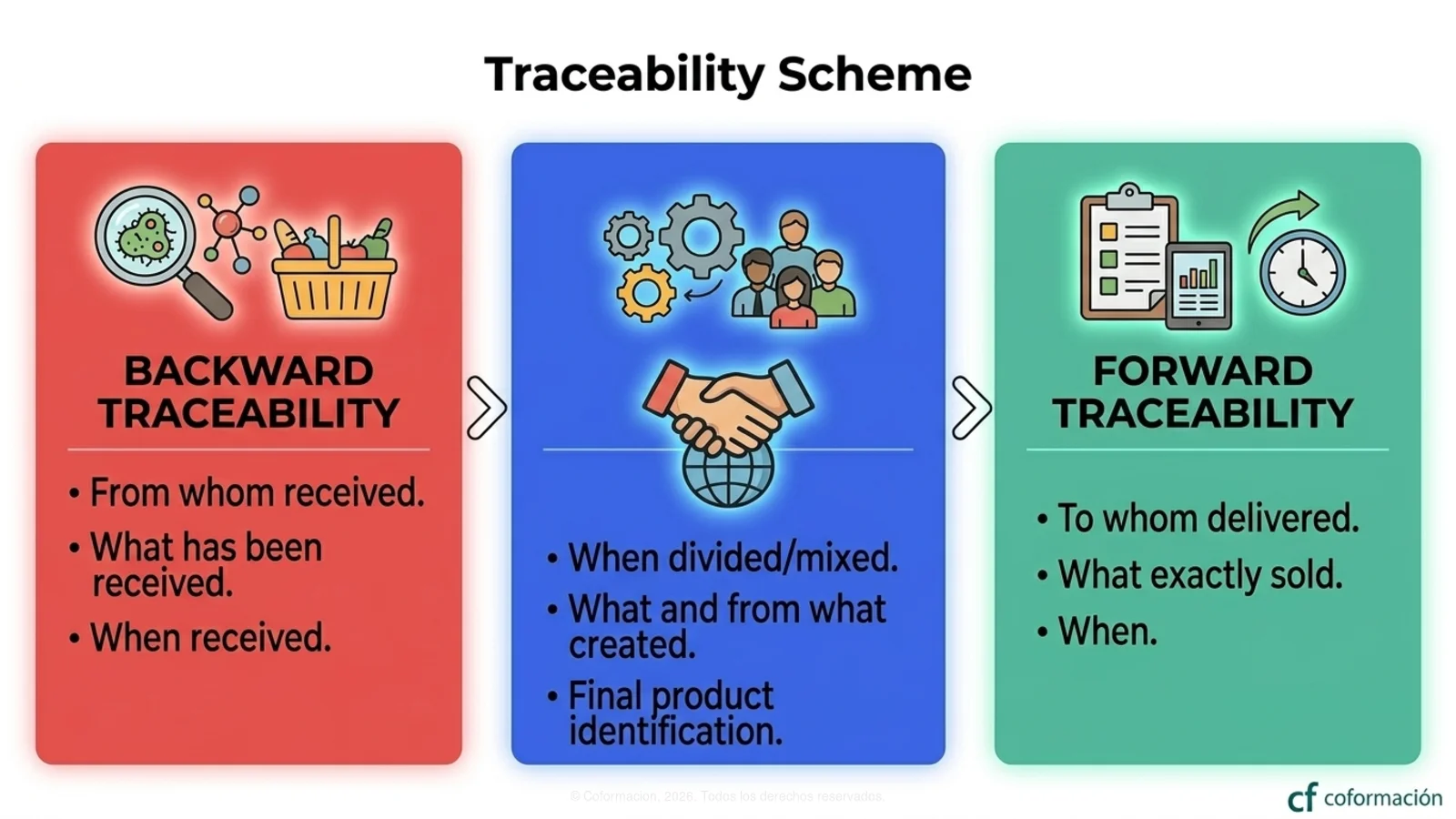
Additionally, Regulation 931/2011 establishes specific traceability requirements for products of animal origin (POA). This includes the minimum information that must be transmitted between operators:
- An exact description of the food.
- The volume or quantity of food.
- The name and address of the food business operator from whom it was dispatched.
- The name and address of the owner of the food (if different from the operator from whom it was dispatched).
- The name and address of the food business operator to whom it is dispatched.
- The name and address of the recipient (owner) if different from the food business operator to whom it is dispatched.
- Identification of the consignment or lot.