
6. Food Handler Hygiene
Although facilities may have the most advanced technology, the human factor remains the heart and engine of food safety. In this module, the focus is directly on you and your daily habits. You will learn how technical handwashing or uniform care are powerful public health tools.
We will review the behaviors to avoid and the importance of reporting our health status.
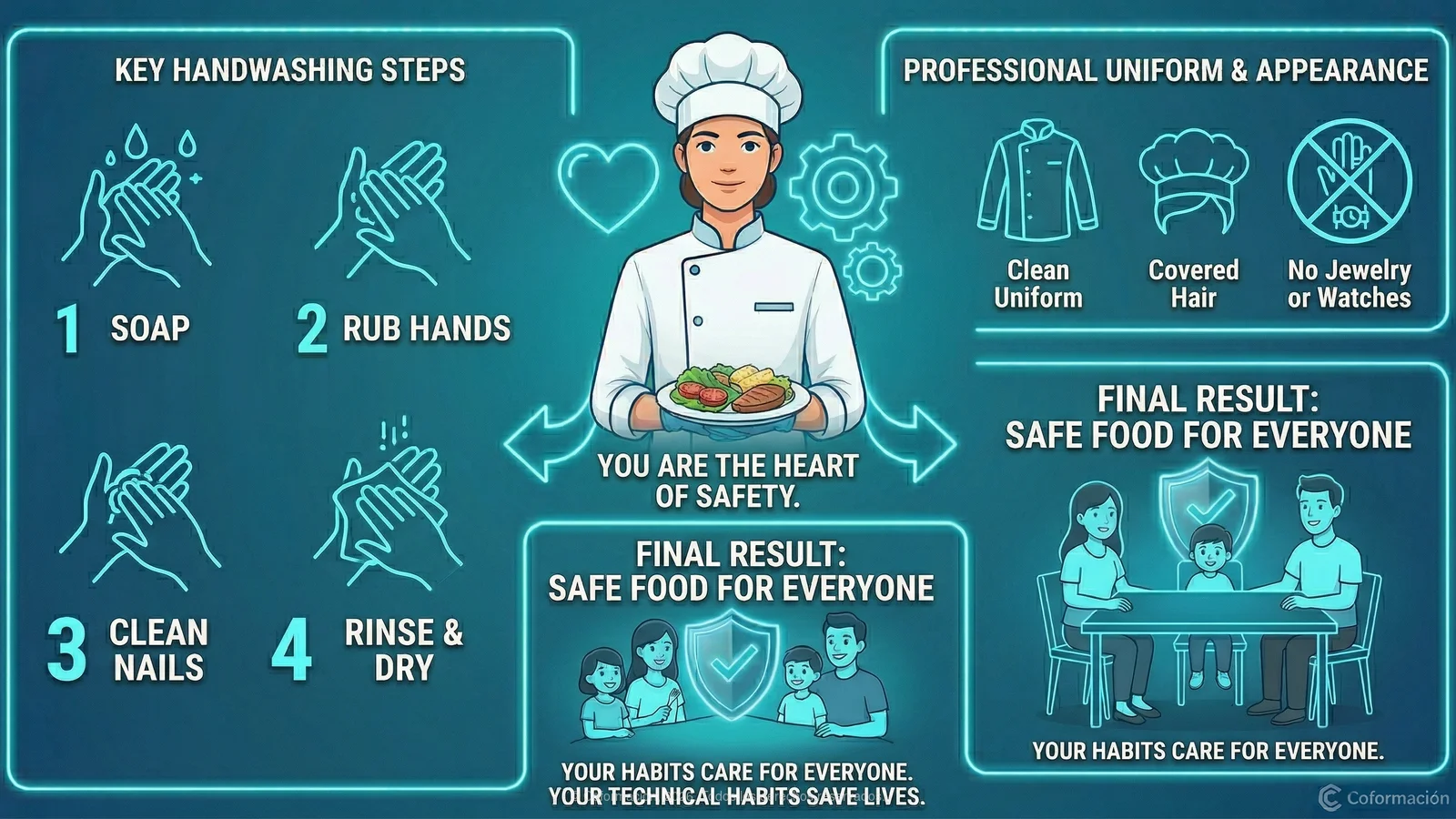
6.1. Personal Hygiene. The Daily Commitment
It is essential for food handlers in any food establishment to maintain proper personal hygiene to avoid food contamination. To this end, it is important to pay special attention to:
6.1.1. Hands
Correct handwashing is performed with warm water and soap, scrubbing all areas (palms, back, between fingers, thumbs, wrists, and nails) for 20 seconds. Finally, they are rinsed and dried with disposable paper.
* Warm water helps to better remove grease and dirt, although the most important elements remain soap and friction. There is no exact mandatory temperature. Use water that is neither too hot nor too cold, that is pleasant to the touch and allows for washing for at least 20 seconds.
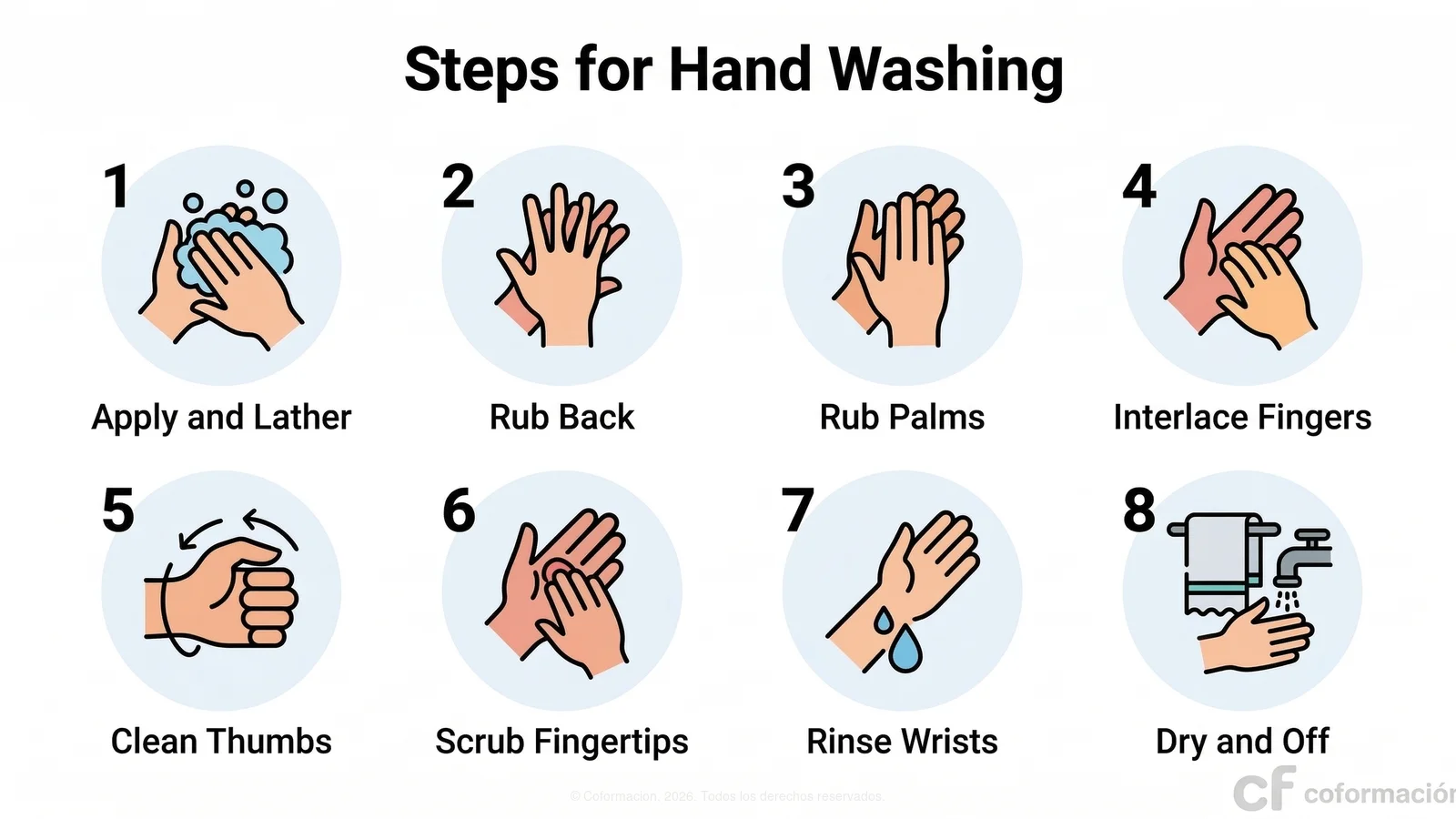
This action shall always be performed:
- After using the bathroom.
- After combing your hair.
- After eating, smoking, or blowing your nose.
- Upon entering a food preparation area and before using equipment or handling any food.
- Between handling raw and cooked foods.
- After handling discarded food, waste, and trash.
Additionally, it is advisable for nails to be as short as possible, to avoid the accumulation of germs inside them, and without polish, as contact with food could alter it.
Due to various circumstances, it may be decided to use gloves. Using them gives the food handler a feeling of having clean hands (because they are protected by the gloves), leading to touching everything and overlooking the need to clean or change the gloves when necessary. It is necessary to change them periodically —not exceeding one hour— whether handling raw foods or ready-to-eat foods. In any case, before putting on gloves, we must wash our hands and remove rings, watches, bracelets, etc.
6.1.2. Hair
In addition to proper hair hygiene, the food handler must know that:
- Hair must be pulled back (whenever length allows) before putting on the work uniform. You should not comb your hair while wearing work clothing, as hair and germs could fall onto the clothes and from there pass to the food and contaminate it.
- The use of caps or hairnets is mandatory, so that hair is completely covered and, therefore, cannot fall into the food.
- Beards must be as clean as possible and, if required, must be protected with a suitable beard cover.
6.1.3. Ears, Nose, and Mouth
These are areas where bacteria accumulate that can cause numerous food poisonings. Therefore, it is essential to follow these hygiene rules:
- Avoid touching your nose, mouth, or ears while handling food; if it happens, you must wash your hands immediately.
- Do not sneeze near food, nor chew gum or eat while working.
- In case of illness, inform the person in charge, who will decide if the person can continue in their position or should perform another task.
6.1.4. Wounds, Cuts, and Abscesses
These injuries facilitate the proliferation of bacteria, becoming a possible source of contamination. For this reason, any wound must be properly cleaned and disinfected, covered with a well-fixed waterproof bandage, and that same bandage must in turn be covered with a glove or finger cot to ensure it does not come loose and fall into the food.
6.1.5. Jewelry and Accessories
Objects such as rings, earrings, watches, or brooches are places where dirt and harmful bacteria easily accumulate, which can then be transferred to food. Furthermore, there is a risk that these objects may come loose and fall into the food, even reaching the consumer.
6.1.6. Clothing
A food handler's work clothing and footwear (including caps and/or beard covers) must be for exclusive use during the work shift. They should not be used outside the work environment or for performing other different activities.
The goal is to maintain the highest possible hygiene, so it is important to change it frequently. Clothing should be light-colored (to easily detect any stains or dirt), with easy-to-wash fabrics, and comfortable, loose, and light to facilitate work.
If the handler combines tasks with food and others such as cleaning or waste management, they must use different clothing for each activity.
It is highly recommended that the company provides double-compartment lockers to physically separate street clothes from work clothes. Street footwear should be stored independently to avoid the spread of germs from the outside.
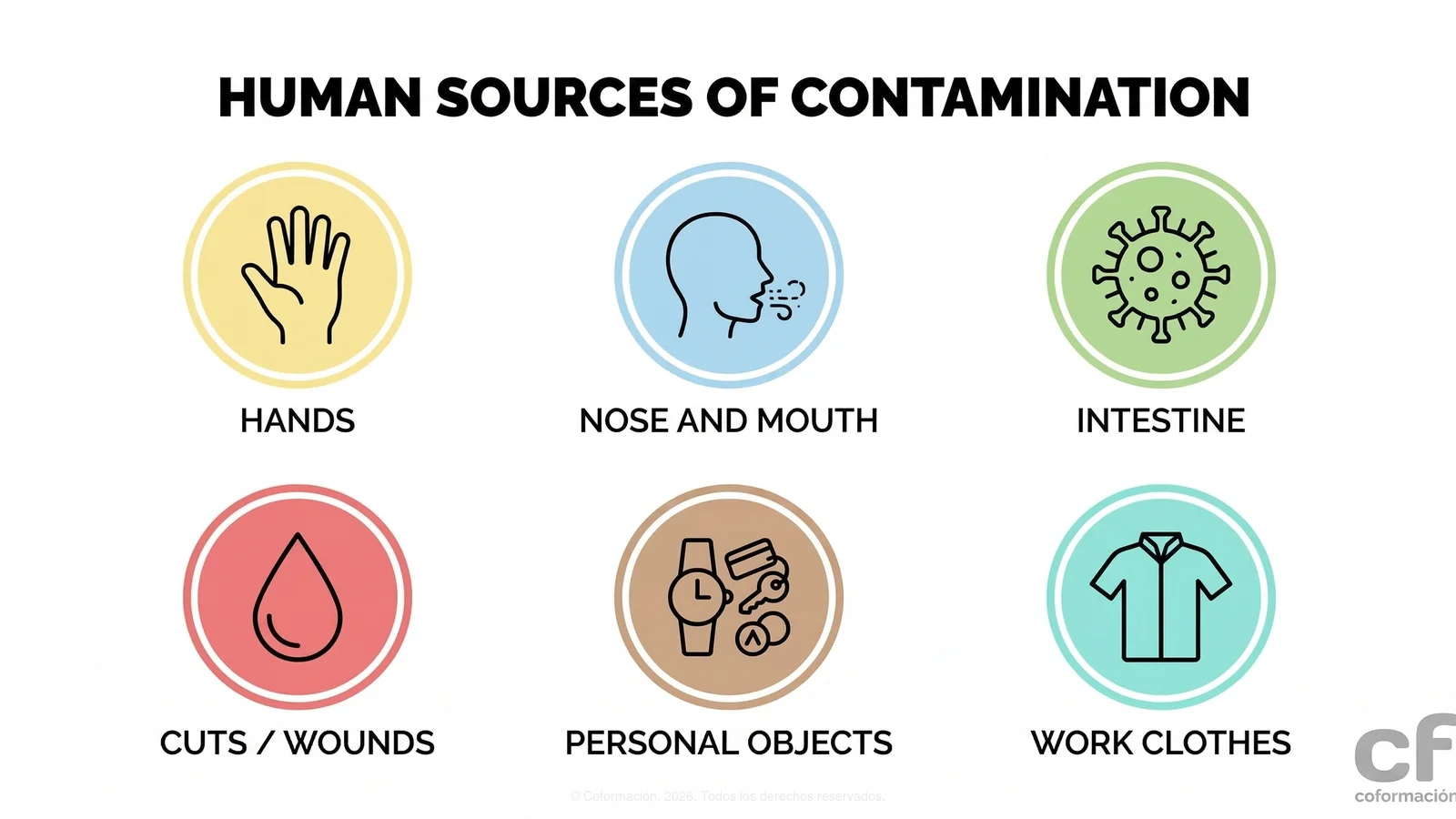
6.2. Hygienic Habits. Prohibited Behaviors
There are daily gestures that, in a kitchen or warehouse, become inadmissible practices due to the risk of contamination they pose:
- Smoking: It is prohibited in all food areas. Hand-to-mouth contact transfers saliva and bacteria to food and equipment.
- Eating/drinking or chewing gum: Promotes the falling of saliva and remains onto the products being handled.
- Sneezing/coughing over food: The handler must step away from the food, turn their head, and cover themselves with a disposable tissue or their elbow, immediately proceeding to wash their hands. Used tissues should never be kept in work clothing.
- Tasting food with utensils without prior and subsequent cleaning: For example: putting a finger in a broth and licking it, using a spoon to taste a broth and stirring it without washing it first... You must always use a clean spoon for each tasting and wash it afterward.
- Performing reflex behaviors: Touching your hair, scratching your head, picking your nose, or rubbing your eyes during service are critical sources of contamination.