
7. Facilities, Water, Labeling, and Pest Control
Your work environment is much more than a physical space: it is your first line of defense. Washing your hands is useless if the machinery has been accumulating dirt for days or if the water you use is not safe. In the end, order and hygienic design are the best guarantee of real cleanliness.
In this block, we analyze how to organize the workflow under the 'forward flow' principle, preventing dirty items from coming into contact with clean ones. We will also address pest control and the safe use of chemical products, so that you can turn your kitchen or warehouse into a fortress against bacteria and unwanted visitors.
7.1. Hygiene of Equipment and Machinery
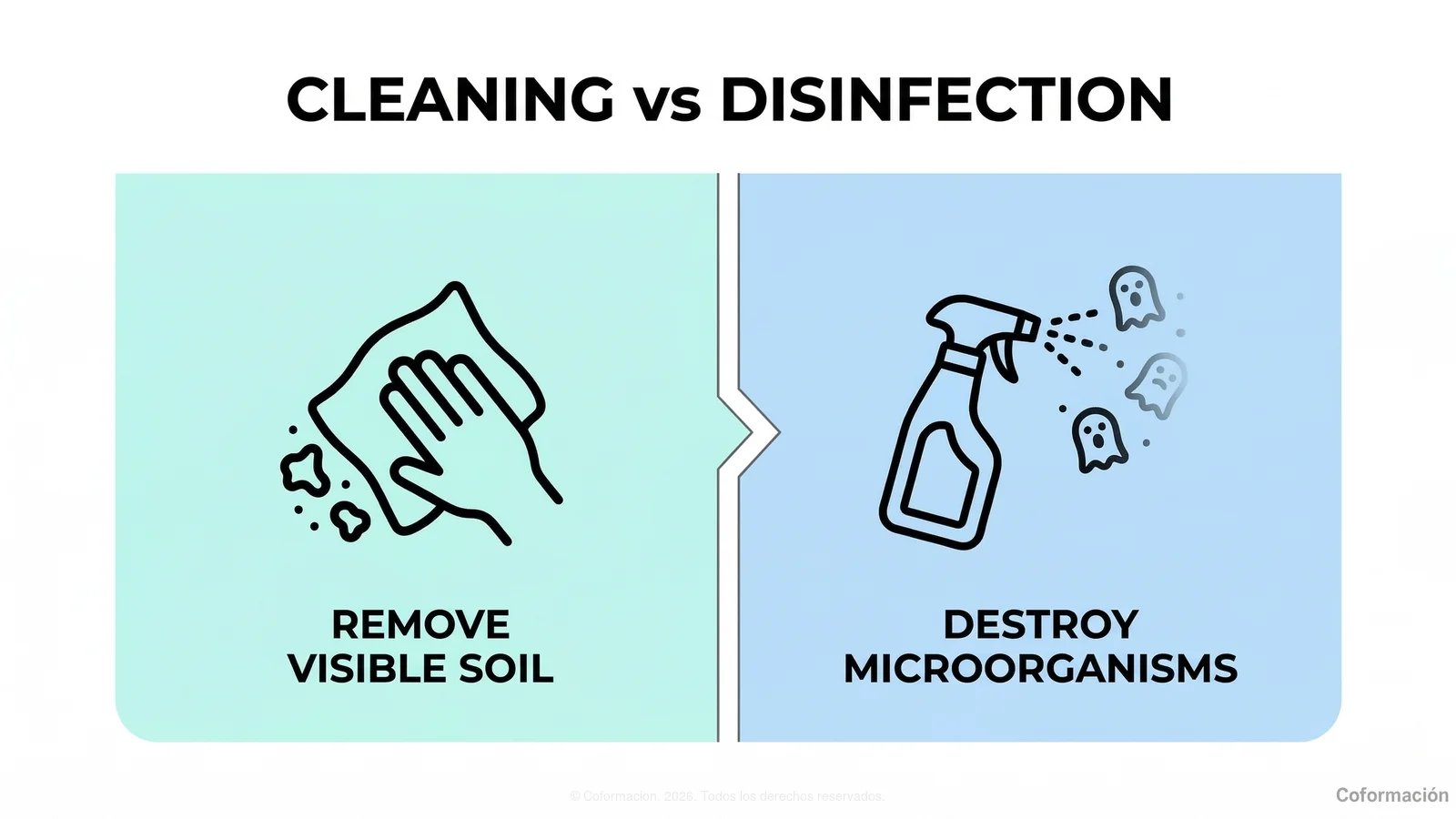
Cleaning and disinfection must be considered the first daily step in food production, and it must be guaranteed constantly throughout the day, and not as an end-of-production or end-of-day activity. By adopting and applying cleaning and disinfection practices, we will be taking the right path to help minimize the risks of food contamination.
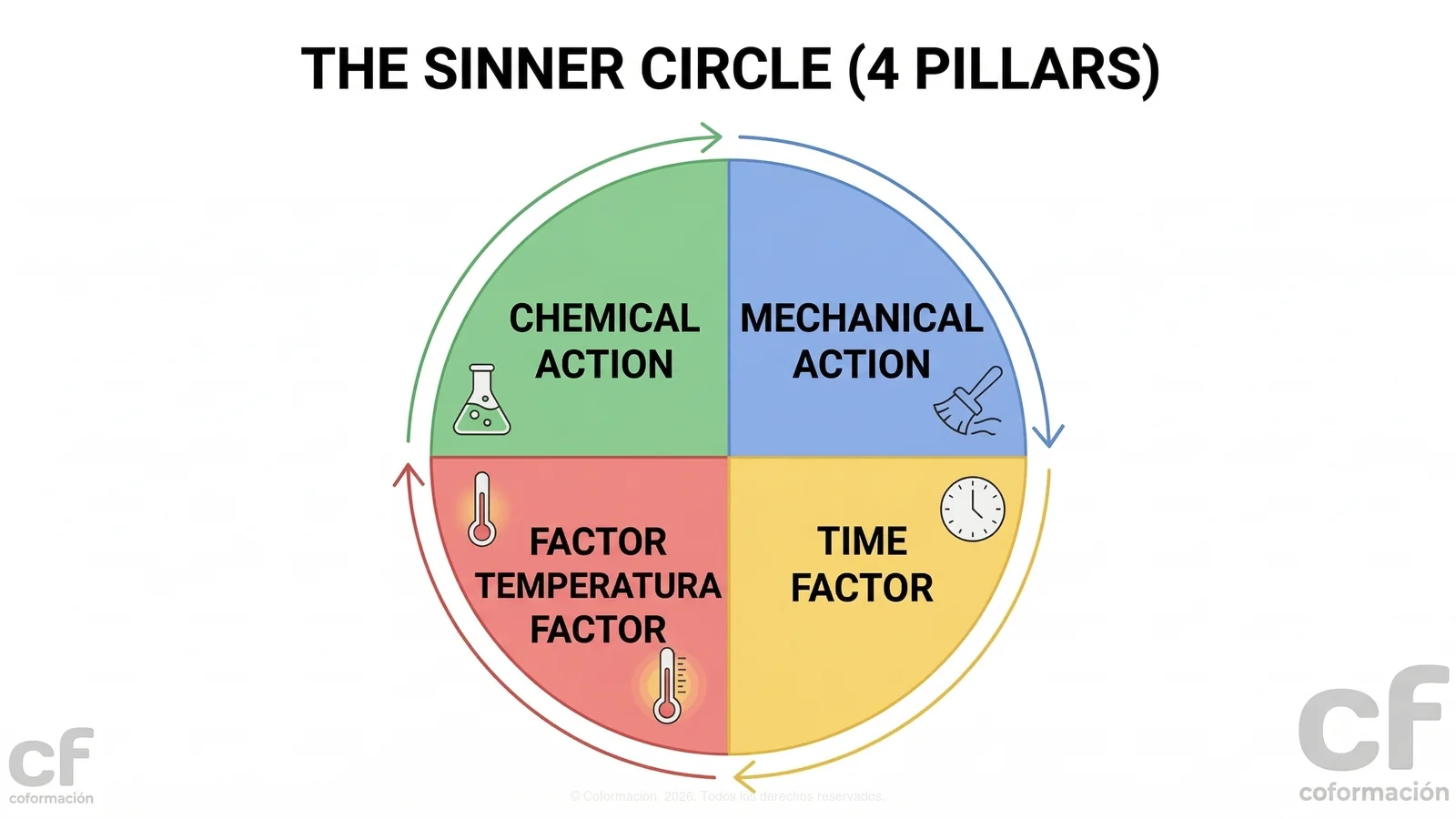
To do it efficiently, 4 parameters must be taken into account:
- Mechanical action: The act of cleaning and disinfecting itself, whether manual (with the movement of the hand when using a cloth or a brush) or non-manual (such as by means of a floor scrubber).
- Chemical action: The set of chemical products: detergents and disinfectants.
- Temperature factor: Adequate temperature for chemical products to perform correctly. It should be chosen based on factors such as the type of dirt and the difficulty of removing it, or the type of chemical product and surface.
- Time factor: The time of the process is influenced by the type of surface to be cleaned, the dirt that has accumulated, the chemical efficiency of the product used, and whether it is a manual cleaning or with some type of machine. Time is essential to allow cleaning and disinfection agents to act effectively.
The scope of the cleaning and disinfection plan will be all those facilities, rooms, equipment, utensils, etc., that are part of the process, and could therefore be a source of contamination for the food product:
- Surfaces in contact with food or the food itself (conveyor belts, hoppers, mixers, injectors, employees' hands, knives, shelves, work tables, all types of utensils, the interior of pipes and tanks, packaging). These are the most critical areas.
- Non-food contact surfaces in close proximity to food and food contact surfaces (exterior and structure of processing equipment, refrigeration units, equipment control panels, switches, walls, floors, drainage system).
- More distant non-food contact surfaces located in or near processing areas (close proximity) (forklifts, pallet jacks, carts, wheels, air covers, hoses, walls, floors, drainage system).
- Non-food contact surfaces outside the processing areas (changing rooms, cafeterias, entrance area, hallways outside the production area, loading docks, finished product storage areas, maintenance areas).
The storage of cleaning and disinfection products must be perfectly labeled, differentiated, and separated from food. Ideally, a cabinet should be available to store these products when they are not in use.
It is forbidden to refill food-use containers with cleaning products. Why? There is a high risk of confusion. For example: in 2022, five people in London suffered severe throat burns because a waiter mistakenly served them shots of caustic soda from a bottle that originally contained tequila.
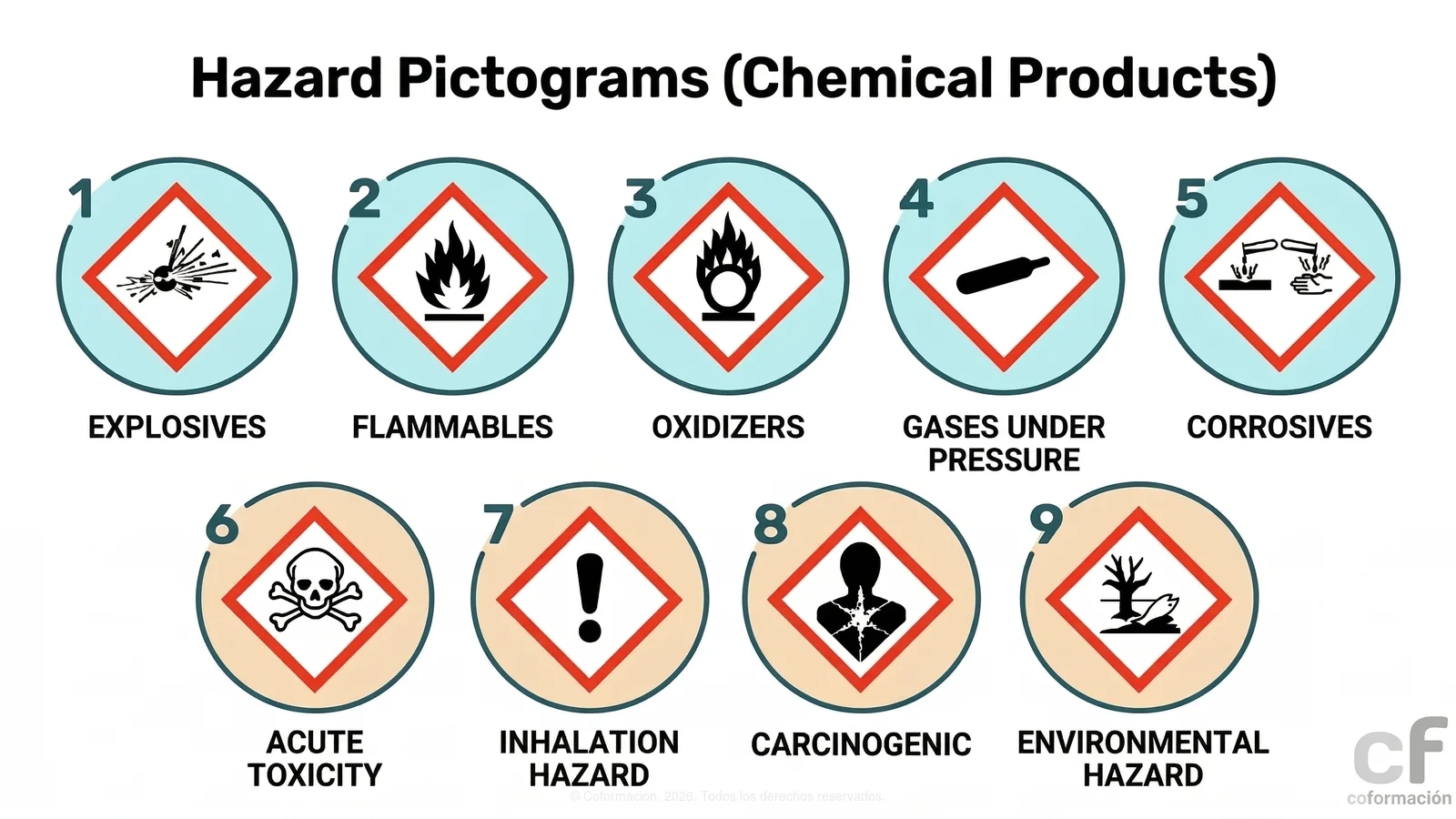
But, in addition to these food safety risks, the incorrect use of some of them can cause accidents, so it is important to read the label, understand the symbols and information printed on it, and use the product as indicated.
7.2. Waste Management
Waste should be disposed of quickly in the trash area, which should be as far away from food as possible. Trash bins are not taken out to the street. Only the bag is removed and deposited in the corresponding waste container. Trash bins must:
- Be as far as possible from the food preparation area.
- Be closed.
- Have a lid and pedal. The lid serves to prevent odors and the entry of animals such as insects or rodents. The pedal allows trash to be disposed of without having to touch the bin with your hands.
7.3. Integrated Pest Control
Pest control is one of the most important ingredients for the food sector. Pest problems can turn into major economic, reputational, and customer losses. The most common pests are: rats, cockroaches, mice, and flies.
This control is carried out through a series of preventive and corrective measures.
A. Preventive Measures
Methods that seek to prevent the appearance of pests:
- Hygiene and cleaning: Keep all areas clean and disinfected frequently, remove food remains and dirt, and avoid trash accumulation.
- Waste management: Use trash bins with lids and pedals, empty waste frequently, keep containers clean and disinfected, and locate trash away from food handling areas.
- Facility maintenance: Seal cracks, holes, or possible entry points, repair water leaks, and install insect screens or weatherstripping on doors.
- Proper food storage: Use airtight containers, apply the FIFO system, and keep products separated from the floor and walls.
- Surveillance and control: Detect signs of pests (droppings, damage, insects) and act quickly at any sign.
- Professional control: Hire specialized services and follow periodic monitoring.
B. Corrective Measures
Methods to eliminate existing pests. These may include traps, toxic baits, insecticides, or disinfection with products authorized by regulatory bodies.
7.4. Water Supply and Quality
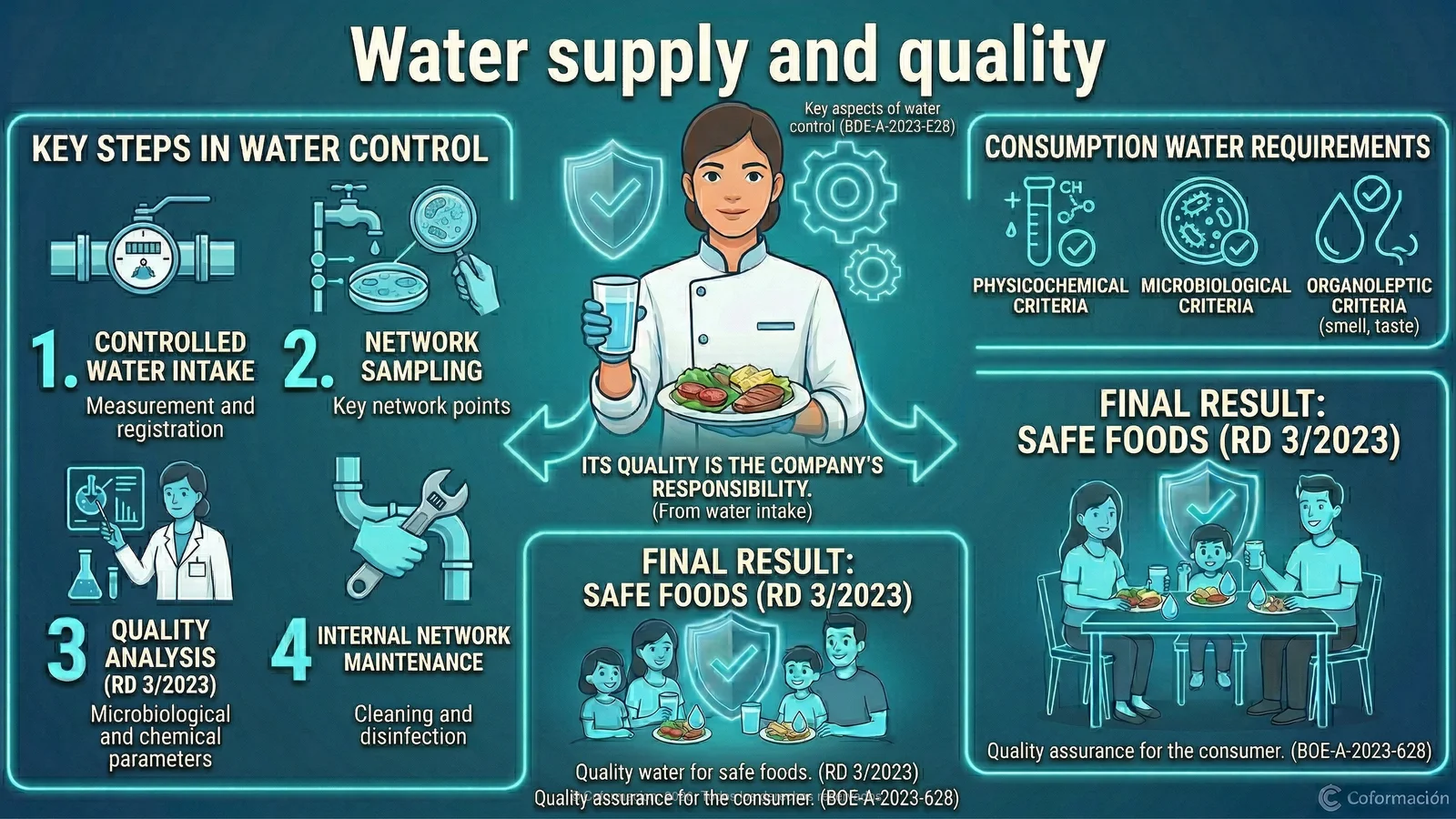
The water used in the food company intended for the manufacturing, preparation, or treatment of food, and the washing of materials intended for contact with food, must comply with the quality criteria established in Royal Decree 3/2023, the company being responsible for this quality from the moment the water enters its facilities. Key aspects of water control:
- Water Use. The Royal Decree distinguishes several important uses:
- Drinking water for cooking, washing food, and utensils. It must be potable.
- Process water → does not come into direct contact. Example: refrigeration.
- Cleaning water → must not contaminate food.
- Periodic analysis: Routine analyses (organoleptic and disinfection) must be performed weekly, along with more complete microbiological and physical-chemical analytical controls to verify potability.
- Critical points: Water must be integrated into the Hazard Analysis and Critical Control Points (HACCP) plan, covering its use in cleaning and as an ingredient.
- Treatment: If tanks or private water (well) are used, it is mandatory to guarantee constant chlorination and disinfection.
- Training: Personnel involved in the handling of drinking water must have the appropriate mandatory training.
- Good practices:
- Maintenance: Inspect tanks and pipes regularly.
- Monitoring: Measure free residual chlorine levels to ensure disinfection.
- Recording: Document all analyses and controls in the self-control plan records.
Failure to comply with these regulations can result in sanctions and serious risks to food safety.