
9. Food Information: Allergen Declaration
For an allergic or intolerant person, what is a common ingredient for others can represent an invisible vital risk that we must know how to manage with total precision. This final module delves into our responsibility when identifying mandatory declaration allergens.
Additionally, we teach you how to organize the kitchen to avoid bad practices that could cause a serious reaction. We are going to see how clear communication is the fundamental pillar that allows consumers to enjoy food with absolute confidence.
9.1. Food Allergies and Intolerances
A proportion of the population (1-3% of adults and 4-6% of children) suffers adverse health consequences as a result of consuming certain foods or food ingredients (AESAN).
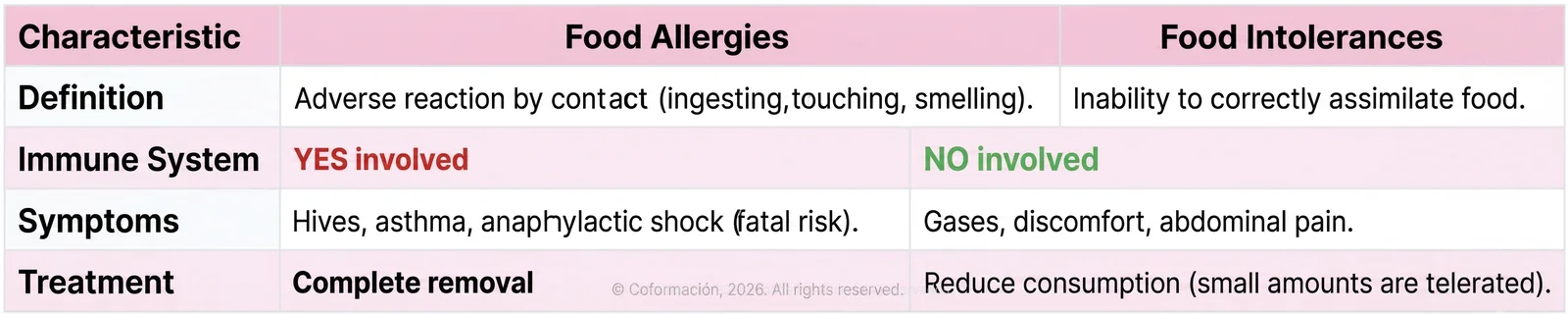
Such hypersensitive responses can manifest in various ways and can be broadly categorized as food allergies or food intolerances.
9.1.1. Mandatory Declaration Allergens
Regulation 1169/2011 lists 14 mandatory declaration allergens:
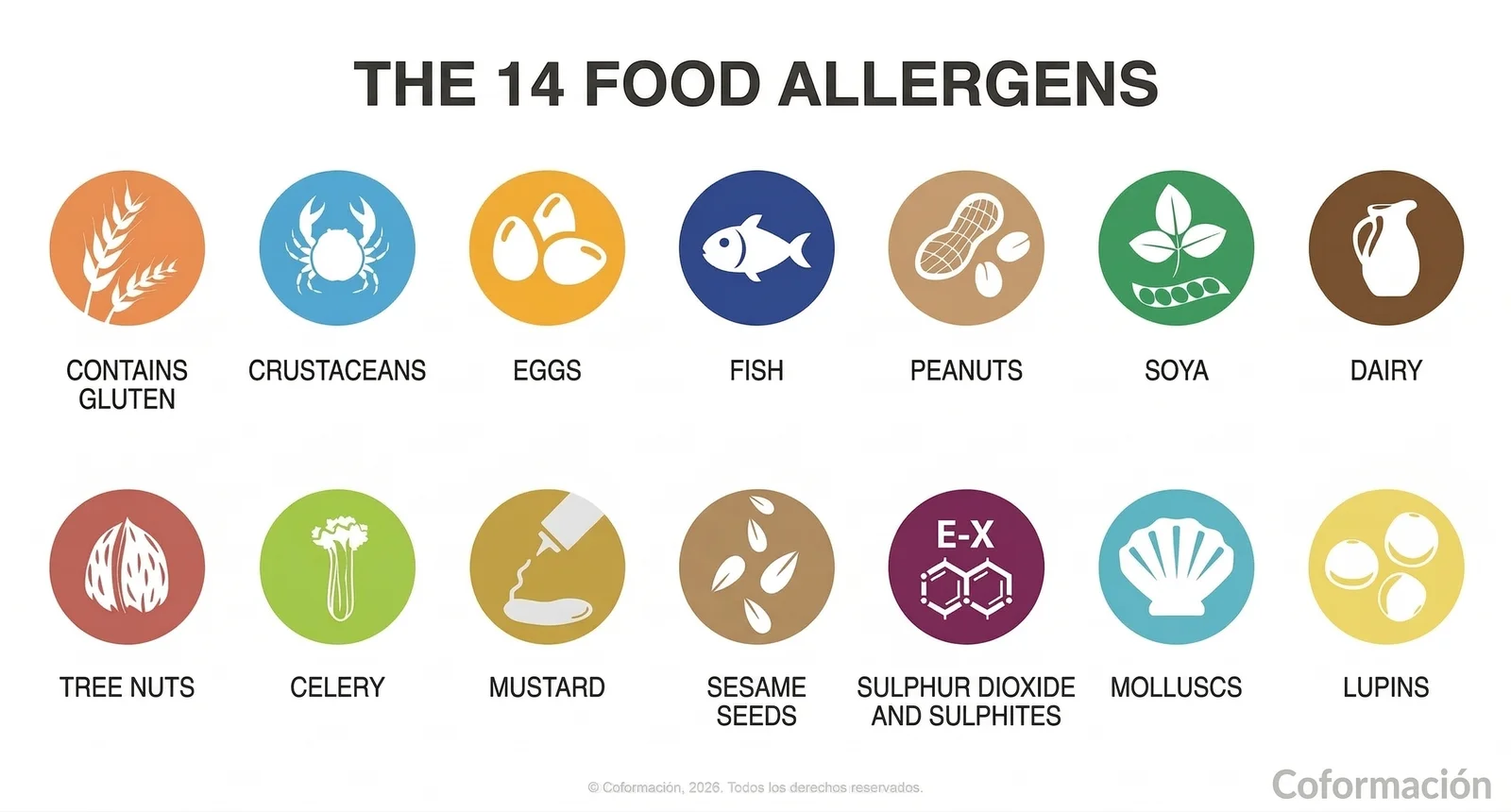
- Cereals containing gluten, namely: wheat, rye, barley, oats, spelt, kamut or their hybridized varieties and derived products.
- Crustaceans and crustacean-based products.
- Eggs and egg-based products.
- Fish and fish-based products.
- Peanuts and peanut-based products.
- Soybeans and soybean-based products.
- Milk and its derivatives (including lactose).
- Nuts, i.e., tree nuts: almonds, hazelnuts, walnuts, cashews, pecans, Brazil nuts, pistachios, macadamia or Queensland nuts and derived products.
- Celery and derived products.
- Mustard and derived products.
- Sesame seeds and sesame seed-based products.
- Sulphur dioxide and sulphites.
- Lupin and lupin-based products.
- Molluscs and mollusc-based products.
IMPORTANT. Do not confuse:
- Milk allergy with lactose intolerance: An allergic person can only have plant-based drinks, but an intolerant person can have lactose-free milk.
- Crustacean allergy with mollusc allergy: Crustaceans are "the ones that crunch," such as shrimp, lobsters, crayfish; molluscs are "the ones with shells," such as snails, clams, mussels, octopus.
- Shellfish allergy: It does not technically exist as a single category. Ask if it is to crustaceans, molluscs, or both.
- Tree nut allergy with peanut allergy: The peanut is a legume, not a nut.
9.1.2. Correct Procedures in Case of Allergies
All staff must know the risks and how to act. It is very important to know the 14 mandatory allergens and know which foods they are present in.
In the dining area (Front of House)
- Always ask the customer if they have allergies or intolerances.
- Provide clear information about the allergens in each dish (menu or fact sheets).
- Correcty note the order, indicating the allergy visibly.
- Communicate immediately to the kitchen the existence of an allergic customer.
- Confirm with the kitchen that the dish is safe and suitable before serving.
- Avoid service errors: do not swap dishes between customers, do not add extra ingredients (sauces, bread, decoration...), serve the correct dish to the correct person.
- Maintain the traceability of the dish from the kitchen to the customer.
- Resolve doubts with confidence (if not known, always consult).
- Deliver the dish clearly indicating it is for an allergic person.
- In case of error or doubt, withdraw the dish immediately.
In the kitchen
- Identify dishes with allergens before starting preparation.
- Always check labels of ingredients.
- Separate raw materials with allergens from the rest.
- Wash hands before handling food without allergens.
- Use clean or exclusive utensils, boards, and surfaces.
- If possible, prepare dishes without allergens first.
- Avoid cross-contamination: do not mix utensils, do not use the same oil, water, or surfaces, do not reuse leftovers.
- Clean and disinfect completely after handling allergens.
- Keep food protected and correctly labeled.
- Verify the dish before serving (correct ingredients).
- Communicate clearly to the front of house that the dish is suitable for allergic persons.
- In case of doubt, do not serve the dish and consult with the person in charge.
9.1.3. Information to the Consumer
The best way to prevent food allergies is through food information, which is the primary means of communication between food operators (producers, sellers, hospitality staff, etc.) and consumers. It allows consumers to know, among other aspects, the composition of foods to make an informed choice of options that are safe for them.
Note. It is important to keep in mind that the allergens highlighted in the ingredient list are only those belonging to one of the 14 indicated groups, as they are the ones with the highest prevalence in the European population. However, there are people allergic to other foods such as fruits (peach, etc.) or legumes (chickpeas, peas, etc.), so it is important to carefully read the entire list of ingredients.

9.2. Legal Framework
- Regulation (EU) 1169/2011: Regulates the information that must be given to the consumer about food. It mandates declaring allergens on labeling in a clear and prominent way.
- Royal Decree 126/2015: Establishes how to inform about allergens in non-prepacked foods. It affects bars, restaurants, and shops, allowing written or verbal information.
- Regulation (EC) 178/2002: Defines the basic principles of food safety in the EU. It establishes that food must not be dangerous, including risks such as allergens.
- Regulation (EC) 852/2004: Regulates hygiene standards in food production. It mandates implementing HACCP systems to control hazards, including allergens.
- Law 17/2011: Reinforces the protection of consumers' health in Spain. It establishes responsibilities and controls regarding food safety, including allergens.