
1. Introduction and Regulations
Welcome to this training space. You will discover here that your daily work goes far beyond a simple job, as you are going to become a fundamental piece for safeguarding public health. This course is not a simple administrative procedure. You represent the first barrier of defense against problems that can have very serious consequences for the population.
Throughout this block, we are going to analyze your role within the food chain, the rules that govern our activity and how the authorities monitor that everything develops correctly. We care not only about the protection of the final consumer but also about your own integrity as a professional.
1. Food Handler. Definition and Responsibilities
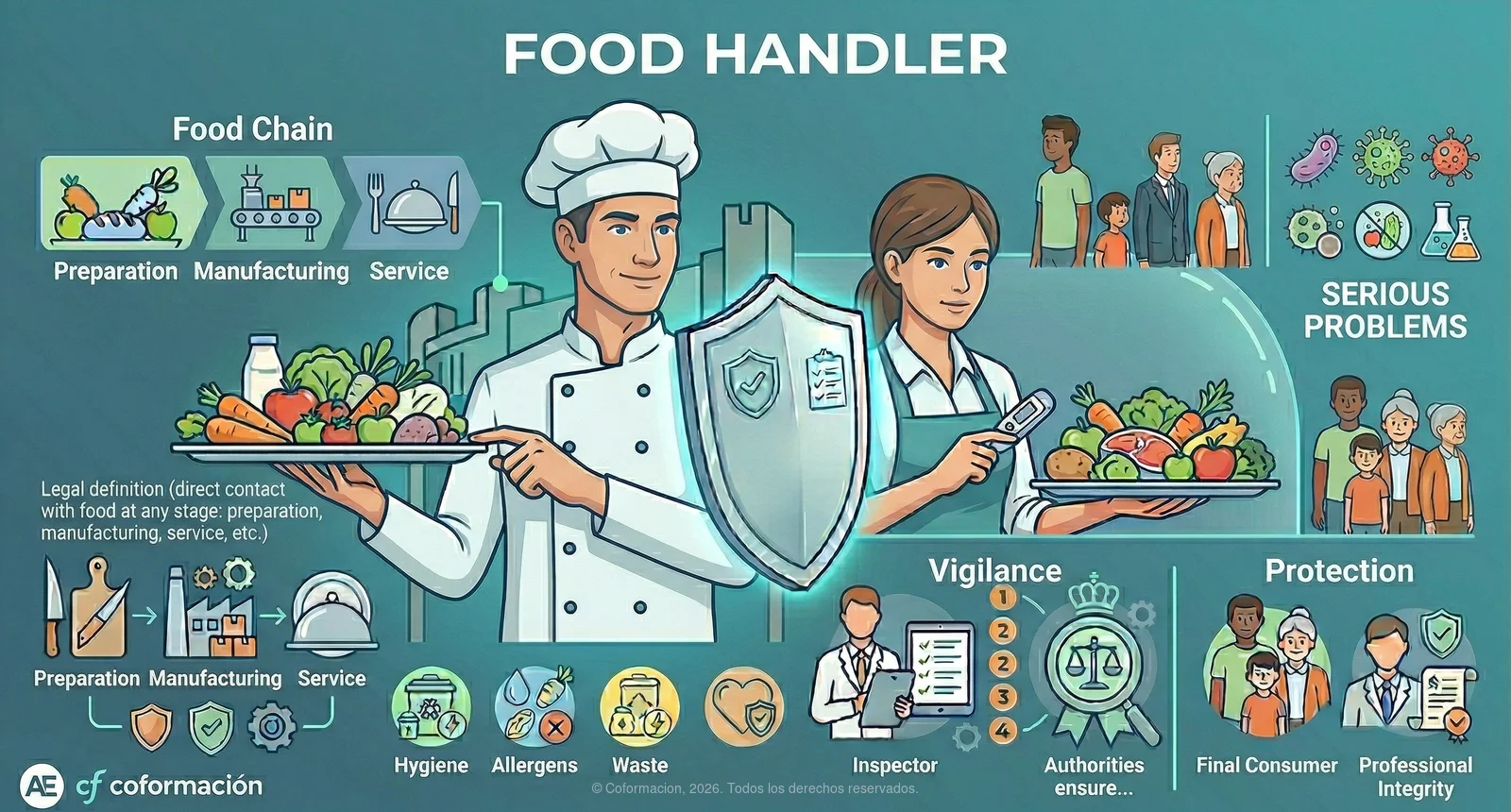
Food handlers are considered to be all those persons who, through their work activity, have direct contact with food during its preparation, manufacturing, transformation, elaboration, packaging, storage, transport, distribution, sale, supply and service (BOE-A-2000-3761).
Handlers must receive training in food hygiene to know and comply with the work instructions established by the company and, in this way, guarantee the safety and healthiness of food (BOE-A-2010-2696).
In the past, this training was justified by the possession of a food handler card, but this requirement was repealed on August 25, 2000. However, the training of people who are going to work as food handlers remains necessary and mandatory.
So, how is it guaranteed that staff training is adequate?
Training is the responsibility of food companies. It is a continuous training. Training programs must be developed and, where appropriate, taught:
- By the company itself.
- By a company or entity authorized by the competent health authority.
1.1. 2026 Regulatory Framework
Food safety is governed by a single and transparent hygiene policy throughout the European Union. The essential regulatory framework that a food handler in Spain must know today is:
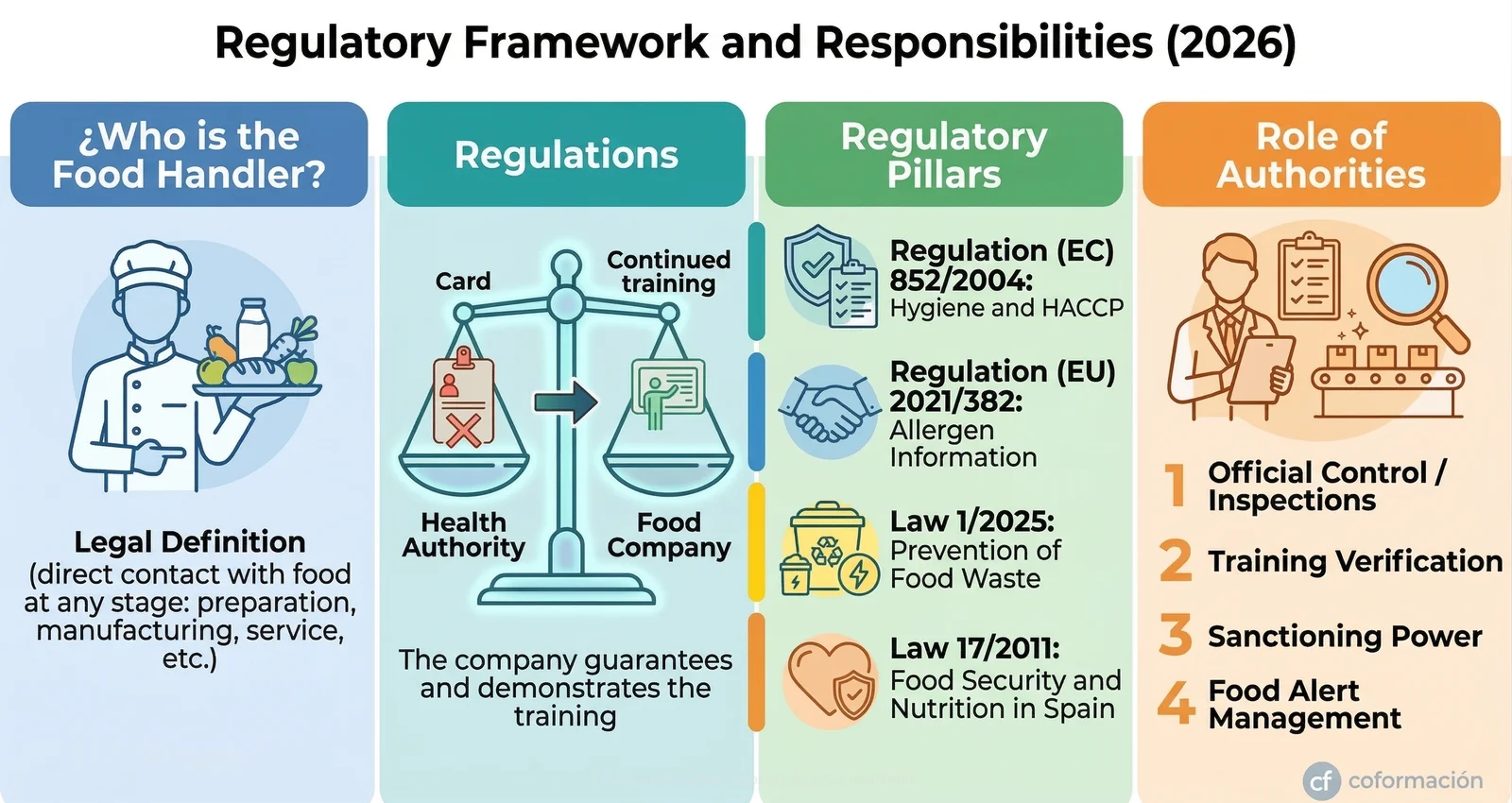
- Regulation (EC) 852/2004: Master standard on the hygiene of foodstuffs. It establishes the obligation to apply the HACCP system, mandatory training for workers and personal hygiene requirements.
- Regulation (EU) 2021/382: Updates Regulation (EU) 852/2004. It introduces the food safety culture, reinforces staff training and supervision, improves hygiene and allergen management requirements and incorporates clearer measures on risk control.
- Regulation (EC) 17/2002: Defines the general framework for food safety and the traceability of food.
- Law 17/2011: Reinforces the system in Spain. It regulates food safety at the national level, official control and the responsibilities of companies and administrations.
- Royal Decree 109/2010: Historical key because it repeals RD 202/2000. This means it eliminates the mandatory card system and transfers the responsibility for training to the company.
- Law 1/2025: Very recent regulation in Spain that regulates the reduction of food waste, obligations for food companies and the hierarchy of food use.
1.2. The Role of Authorities
With the new Royal Decree 109/2010, competent authorities stop authorizing handler training and move to perform official control functions, supervising through inspections that companies guarantee adequate training and compliance with food hygiene regulations (BOE-A-2010-2696).
- Official control: The administrations (health, inspection), are in charge of performing sanitary inspections and verifying that Regulation (EC) 852/2004 is complied with. That is, they move from authorizing before to controlling after.
- Verification of handler training: They do not train directly, but they do check that workers have received adequate training and that training is sufficient for their position. That is, that the training is applied in practice (not only on paper). The company must be able to demonstrate it in inspection.
- Surveillance and food safety: They protect public health, acting in the face of risks (alerts, product recalls, etc.).
- Sanctioning power: If they detect non-compliance, they can impose sanctions and even close establishments in serious cases.
- Guides and recommendations: Through bodies such as the Spanish Agency for Food Safety and Nutrition (AESAN) they publish good practice guides and guide companies and workers.
About the Certificate
After passing the exam, you will receive your 100% legal Food Handler certification. We will send the certificate to your email immediately after payment is completed.
To obtain the certificate, you have access to all course modules, which provide comprehensive training to identify and analyze the occupational risks associated with the various tasks involved in these roles.