
8. Self-Control Systems. Prerequisites and HACCP
The time has come to take command of daily operations through a system that organizes every detail without leaving anything to chance. Self-control is the 'brain' that guarantees safety at all times, the roadmap that ensures that every dish that leaves the kitchen is 100% safe.
In this section, we discover the 7 principles of the HACCP system and the vital importance of documentary records, which are not simple papers, but the real evidence that each dish served has been prepared under professional control.
8.1. Introduction
The HACCP system is a Hazard Analysis and Critical Control Point system currently recognized and accepted internationally to guarantee food safety. In fact, Regulation (EC) 852/2004 itself establishes that "food business operators shall create, apply and maintain a permanent procedure or procedures based on the HACCP principles" (DOUE-L-2004-81035).
Main Characteristics
- Prevention: Prevents hazards from reaching the consumer.
- Systematic: Follows an orderly and logical process.
- Risk-based: Identifies biological, chemical, and physical hazards.
- Focused on critical points: Controls key stages of the process.
- Measurable and verifiable: Allows for monitoring and records.
- Documented: Everything is recorded for control and auditing.
- Adaptable: It applies to any company or type of food.
Companies must clearly detail all measures taken to ensure adequate control of hazards and, in case of deviation, the corrective actions carried out.
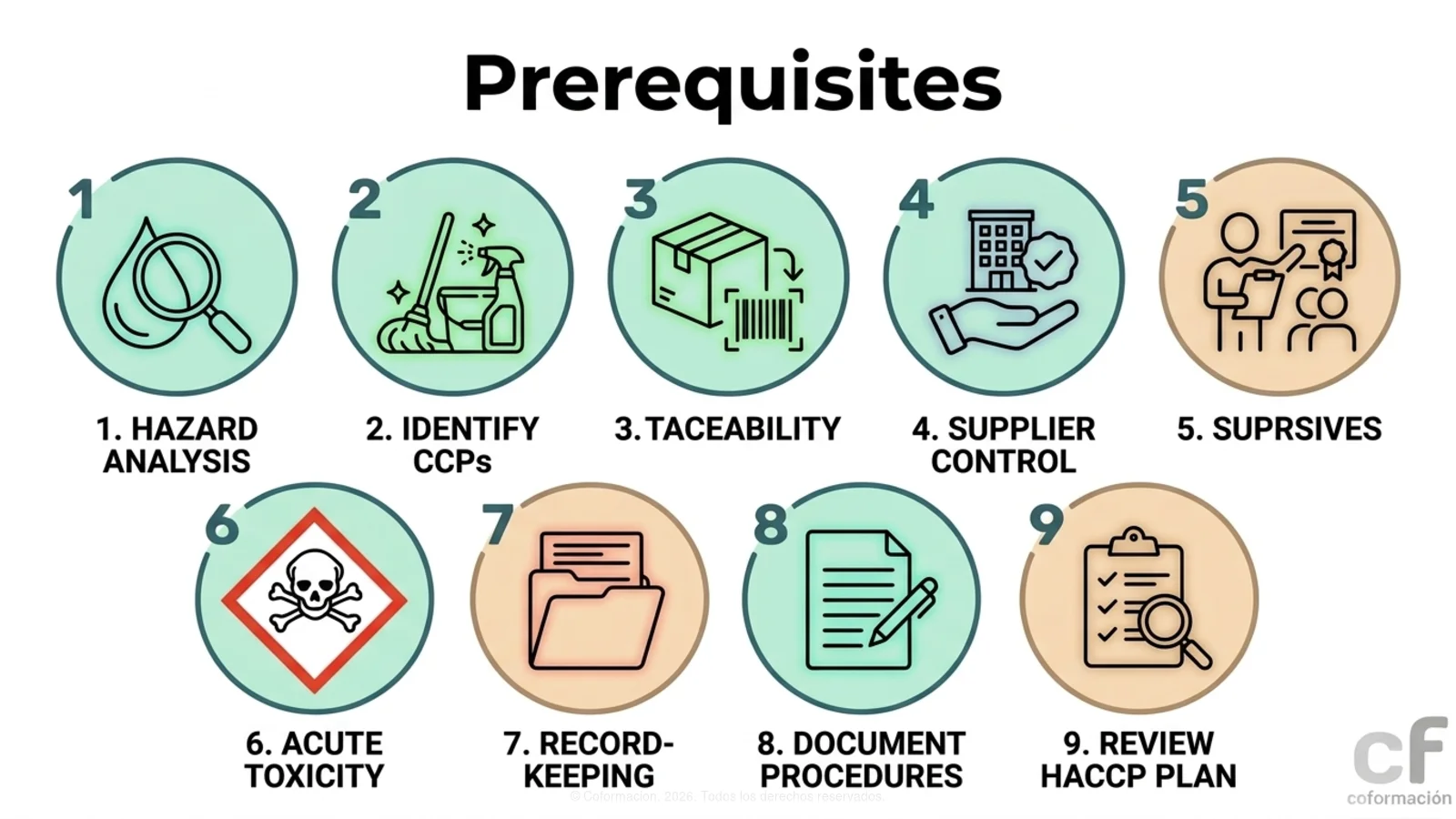
However, prior to the implementation of the HACCP system, it is indispensable to have a prerequisite program. The essential function of these programs is to control certain types of hazards, lightening the "workload" of the HACCP plan, which leads to improved operability and effectiveness. In this sense, the implementation of prerequisite programs should serve to greatly reduce critical control points (CCPs).
Specifically, the prerequisite program must cover all process conditions:
- Water control plan.
- Cleaning and disinfection plan.
- Pest control plan.
- Training plan.
- Facility maintenance and equipment calibration/verification plan.
- Traceability plan.
- Supplier control plan.
8.2. HACCP Principles
There are 7 basic principles that must guide every HACCP system:
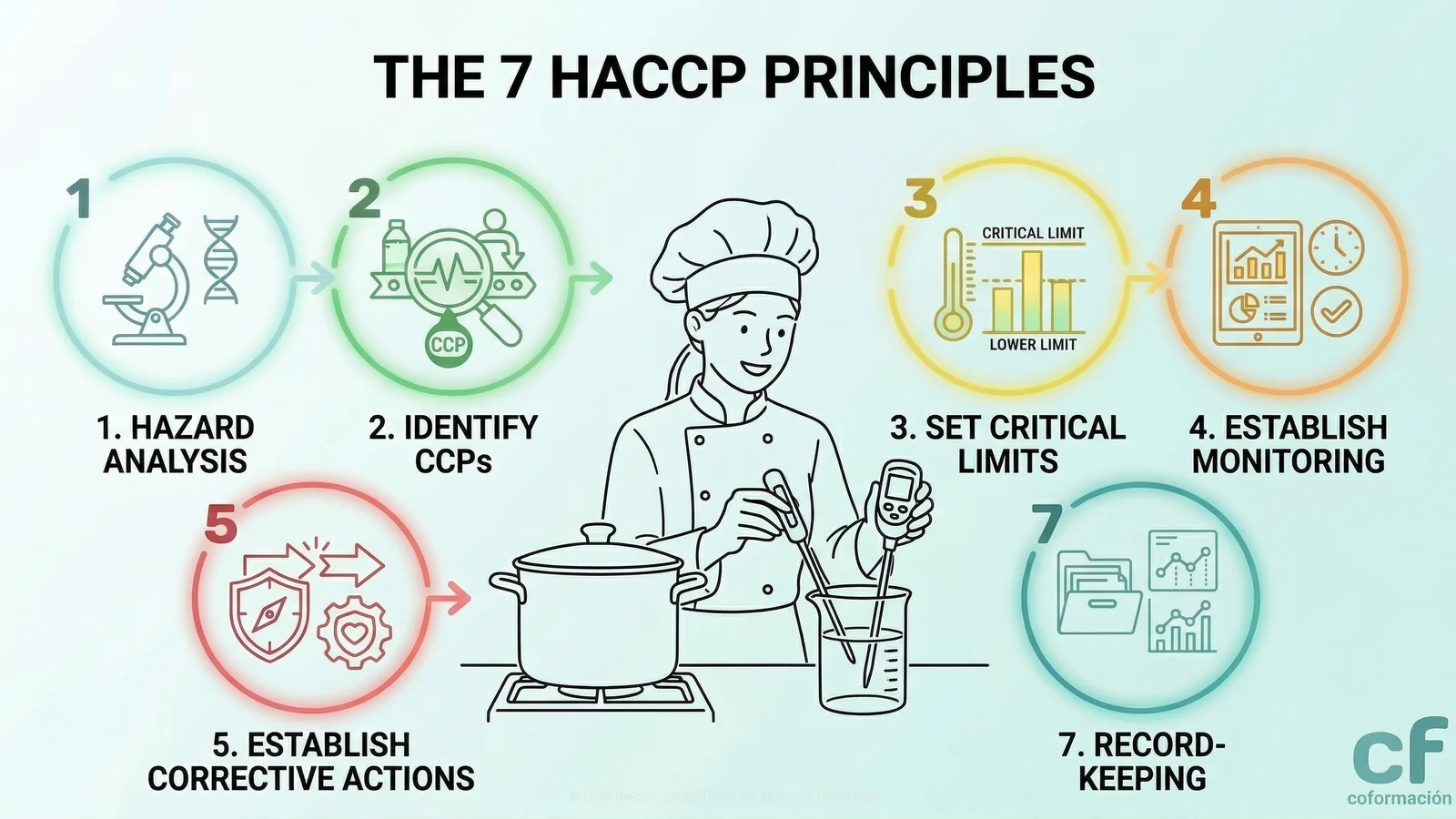
- Principle number 1: Identify any hazards that must be avoided, eliminated, or reduced to acceptable levels.
- Principle number 2: Determine the critical control points (CCPs) at the step or steps where control is essential to prevent or eliminate a hazard or to reduce it to acceptable levels.
- Principle number 3: Establish for each critical control point, critical limits which distinguish acceptability from unacceptability for the prevention, elimination, or reduction of identified hazards.
- Principle number 4: Establish and apply effective monitoring procedures at identified critical control points.
- Principle number 5: Establish corrective actions when monitoring indicates that a critical control point is not under control.
- Principle number 6: Establish procedures, which shall be carried out regularly, to verify that the measures outlined in the five previous sections are effective.
- Principle number 7: Create documents and records commensurate with the nature and size of the food business to demonstrate the effective application of the measures outlined in the six previous principles.
8.3. Records
Regulation 852/2004 makes it clear that food business operators shall keep and preserve records on the measures applied to control hazards in an appropriate manner and for an appropriate period, taking into account the nature and size of the food business (DOUE-L-2004-81035).
Self-control records are documents where control and monitoring activities performed within a food safety system are recorded. That is, they arise from the mandatory implementation of the HACCP system or prerequisites explained previously.
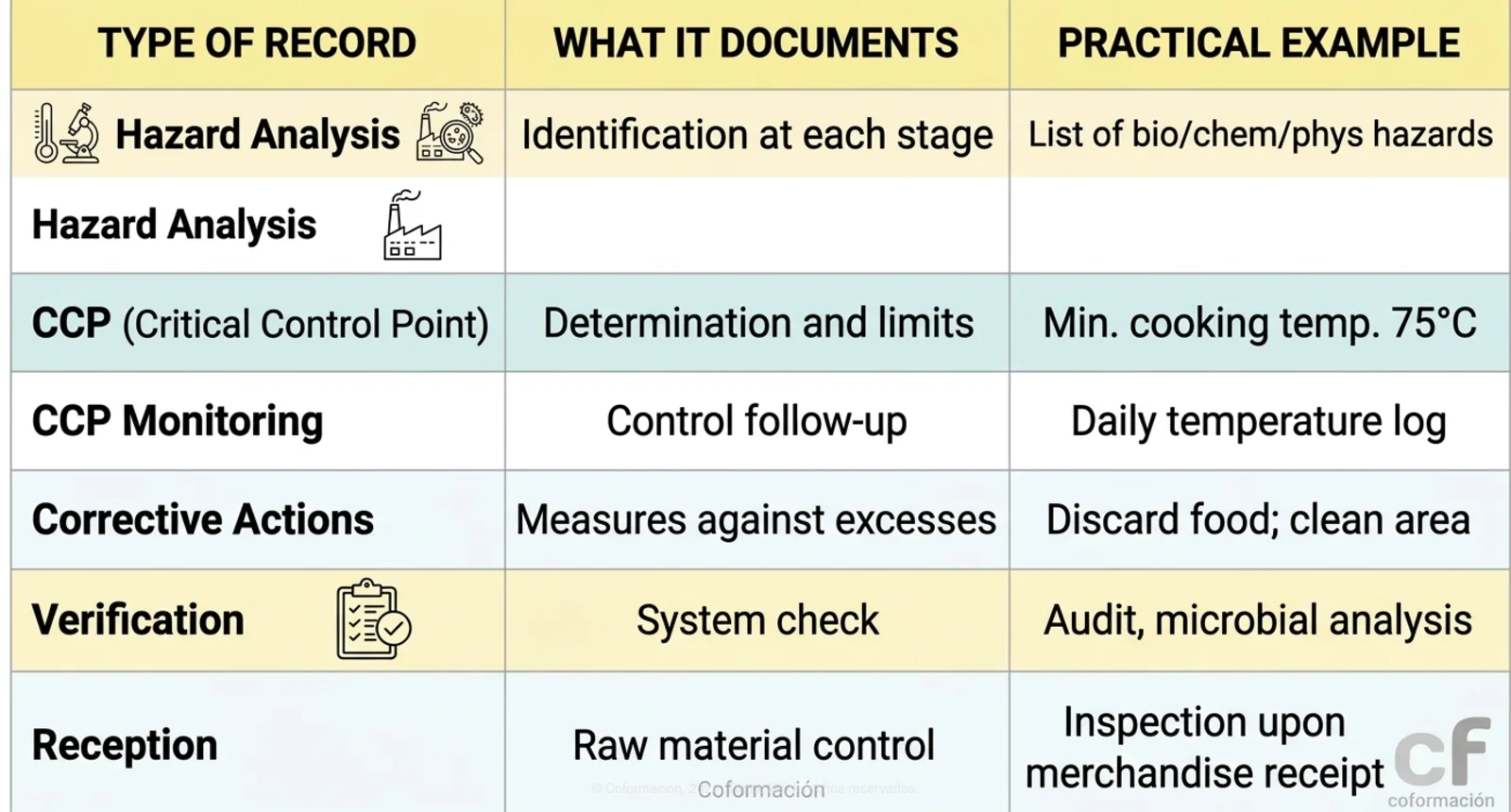
The main objective is to document and verify that food safety measures are being applied correctly during all stages of the food handling process. In this way, controls can be monitored and corrective actions can be taken when necessary.
It is important that they are signed by the person who completes them, to ensure responsibility and traceability, and that they are filled in with real data and at the appropriate time. For example: a chamber temperature record must be completed first thing in the morning to ensure, before starting the workday, that the temperature of the chambers is correct and the products inside are in good condition.